If your child’s dentist has recommended dental sealants and you are not entirely sure what they are or whether they are actually needed, you are not alone. Sealants are one of the most consistently recommended preventive treatments in pediatric dentistry, but they are also one of the least understood by parents. The recommendation can feel like an upsell when you do not have the context to evaluate it.
This article covers what dental sealants are, how they work, which teeth benefit from them, what the evidence says about their effectiveness, and how to think about the decision for your child specifically.
What are Dental Sealants?
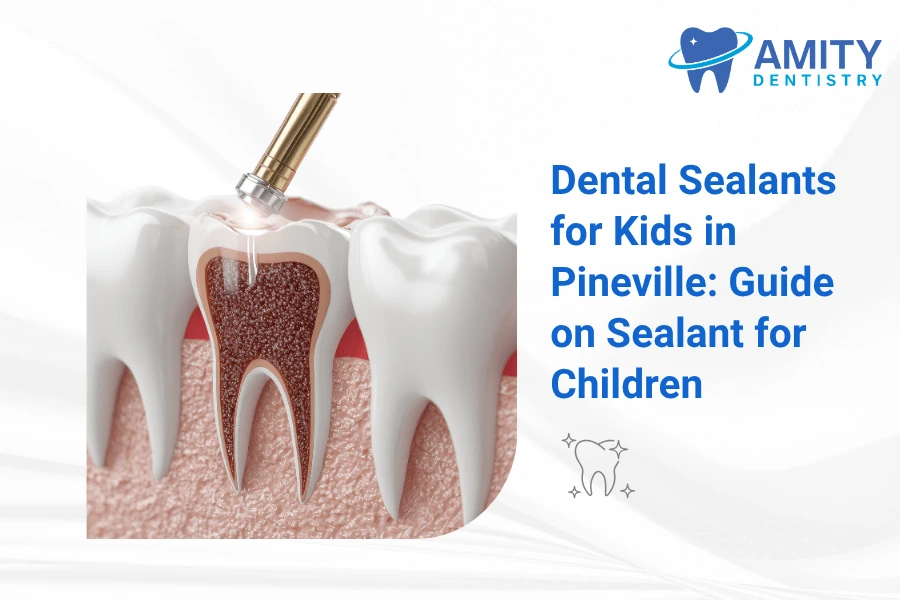
A dental sealant is a thin plastic coating applied to the chewing surfaces of back teeth, primarily molars and premolars. The coating bonds into the grooves and pits of the tooth surface, creating a smooth barrier between the tooth enamel and the bacteria and food particles that cause decay.
The application takes only a few minutes per tooth and involves no drilling or removal of tooth structure. The tooth is cleaned, a mild acid solution is applied briefly to help the sealant bond, the surface is rinsed and dried, and the sealant material is painted on and hardened with a curing light. The result is a sealed surface that is easier to clean and significantly more resistant to the decay that starts in the deep grooves of molar teeth.
Sealants are clear or slightly white in appearance and are not visible when a child smiles. They do not affect how the teeth feel when biting and children typically forget they are there within a day.
Why Molars Are the Target for Sealant Procedures
Understanding why sealants target molars specifically requires a brief look at tooth anatomy. The chewing surfaces of molar teeth are not flat. They have a complex topography of ridges, cusps, grooves, and pits that makes them effective for grinding food. These same features also make them exceptionally good at trapping food particles and bacteria.
The grooves in molar teeth are often narrower than a single toothbrush bristle. No matter how well a child brushes, these grooves cannot be fully cleaned by mechanical brushing alone. Bacteria accumulate in the depths of these grooves, produce acid from the sugars in food, and begin breaking down enamel in a location that is structurally difficult to reach and treat once decay has started.
The Centers for Disease Control reports that the chewing surfaces of back teeth account for approximately 90% of cavities in children. That figure reflects the anatomical reality that these surfaces are where decay preferentially starts, not that children are brushing their front teeth better than their back teeth.
Sealants address this specific vulnerability by eliminating the grooves as a decay site. A sealed molar has a smooth surface that brushing cleans effectively and where bacteria cannot establish the foothold they need to start cavity formation.
When Sealants Are Applied
Timing the application of sealants to tooth eruption is important because the window for effective sealant application is early. A sealant applied to a tooth that already has early decay sealed in underneath it creates a different problem. Sealants are applied to healthy tooth surfaces shortly after eruption, before decay has had the opportunity to begin.
The first permanent molars, sometimes called the six-year molars, erupt around age six. They arrive behind the existing primary teeth without a baby tooth falling out first, which means many parents do not notice them. These are the first permanent teeth that erupt and they are at immediate decay risk from the moment they break through the gum surface.
The second permanent molars erupt around age twelve, behind the first permanent molars. These receive sealants at the same point in their eruption cycle.
Primary molars can also receive sealants in children assessed as high risk for early childhood decay. The decision to seal primary teeth weighs the decay risk against the relatively shorter time those teeth will be present, and is made case by case based on the child’s individual risk profile.
The window for sealant application on each tooth is typically the first year or two after eruption. After that, either the tooth has remained cavity-free and the sealant is applied as late prevention, or decay has begun and requires treatment before any sealant work is relevant.
The Evidence for Sealants over Reduction in Molar Decay
Dental sealants have one of the stronger evidence bases in preventive dentistry. The CDC’s Community Preventive Services Task Force recommends sealant programs as an effective public health intervention based on a body of research showing consistent reduction in molar decay.
Studies consistently show that sealed molars develop significantly fewer cavities than unsealed molars in the same population over the same time period. Research published across multiple decades and geographies shows decay reduction rates in the range of 80% in the first two years after application, declining gradually as sealants wear over time but remaining protective for several years when intact.
Sealants also hold up economically. The cost of applying sealants to a child’s first and second permanent molars is substantially lower than the cost of treating the cavities that would develop in those teeth without sealant protection. A cavity in a permanent molar requires a filling that itself has a finite lifespan and may eventually need replacement or more extensive restoration. Preventing that cavity with a sealant in the first place is a straightforward cost-benefit calculation.
How Long Sealants Last?
Sealants are durable but not permanent. They wear gradually with normal chewing function and can chip or partially detach over time. The dentist checks sealant integrity at each routine visit and reapplies sealant material to areas that have worn or detached. Full reapplication of a sealant is a simple procedure, similar in length and method to the original application.
The practical lifespan of a well-maintained sealant is several years. Children who attend routine dental visits every six months have their sealants monitored at each appointment, ensuring that any loss of coverage is identified and addressed before it creates a vulnerable unprotected surface.
Some parents assume that because sealants wear, they are not worth applying. The relevant comparison is not between a perfect permanent sealant and a worn sealant. It is between a protected tooth during the years of highest decay risk and an unprotected tooth during that same period. Even partial and intermittent coverage during the years when molar decay most commonly begins provides meaningful protection.
Do Sealants Replace Brushing and Flossing
No. Sealants protect the chewing surfaces of molar teeth. They do not protect the sides of teeth, the spaces between teeth, or any other surface of the mouth. Cavities also develop between teeth where food and bacteria accumulate in areas that only flossing reaches. Sealants complement good home care and fluoride exposure. They do not substitute for either.
A child with sealants who does not brush or floss consistently is still at significant decay risk from the surfaces sealants do not cover. The full preventive picture involves brushing twice daily with fluoride toothpaste, flossing once daily, a diet that limits frequent sugar exposure, fluoride from water or supplementation where indicated, regular dental visits, and sealants as one protective layer among several.
Are Sealants Safe for Children?
Sealants are among the most studied dental materials used in children. The American Dental Association, the American Academy of Pediatric Dentistry, and the American Academy of Pediatrics all endorse sealants as safe and effective.
Early sealant materials used bisphenol A (BPA) in their composition, which raised parental concern for a period. Current sealant materials contain minimal or no BPA and the exposure from sealant application, even in earlier formulations, was determined to be negligible compared to everyday environmental BPA exposure from food packaging and other sources. If you have specific concerns about the materials your child’s dentist uses, asking which sealant product is used and reviewing its composition is a reasonable question that any pediatric dental practice should answer directly.
Sealants in the Context of Pineville
Pineville families using dental practices in the area have access to the same preventive dental standards as any metropolitan Charlotte area practice. For children attending school in Pineville and the surrounding communities, the combination of school lunch diets, snacking habits, and the developmental window of molar eruption creates exactly the conditions where sealants deliver consistent value.
Children in the six to twelve age range are in the peak window for first molar sealant application. If your child is in this range and has not had their permanent molars checked for sealant eligibility, a conversation with the dentist at the next routine visit is the practical starting point. The dentist assesses whether the teeth have erupted sufficiently, whether the surfaces are healthy enough for sealant application, and whether the child’s overall decay risk profile makes sealants a priority.
Amity Dentistry serves families in Pineville with preventive dental care that includes sealant assessment and application as part of the routine care pathway for children in the appropriate developmental window. The practice takes a risk-based approach to sealant recommendations, meaning the recommendation is grounded in the individual child’s tooth eruption status, decay history, and home care habits rather than applied uniformly without clinical consideration.