Most parents do not think about dental visits until their child has a full set of teeth, or until something hurts. By that point, habits have already formed, early decay may have started, and the first dental experience is happening under stress rather than in a calm, routine setting. Timing the first dental visit correctly changes the entire trajectory of a child’s relationship with oral health.
The short answer is earlier than most parents expect. The longer answer involves understanding what happens at that first visit, why it matters at different developmental stages, and what to look for in a pediatric dental practice in Charlotte that makes the experience work for young patients.
When Should a Child First See Dentist: The One-Year Rule
The American Academy of Pediatric Dentistry recommends that a child’s first dental visit happen by their first birthday or within six months of the first tooth appearing, whichever comes first. Most children cut their first tooth between four and seven months. That puts the first recommended dental visit well before most parents have considered it.
This timeline surprises many families. A one-year-old with a handful of small teeth does not look like a dental patient. But the first visit is not primarily about treating problems. It is about establishing a relationship with a dentist, creating a baseline record of how the teeth and jaw are developing, and giving parents practical guidance on caring for an infant’s mouth at home.
The earlier a child begins seeing a dentist, the more routine the experience becomes. Children who first visit a dentist at age five or six, often triggered by a problem, face a much steeper adjustment than those who have been coming in annually since infancy. The environment, the sounds, the instruments, and the people are all unfamiliar. A child who has been coming since age one knows the drill in the best possible sense.
What Happens at the First Pediatric Dental Visit
The first visit for an infant or toddler is structured around comfort and information rather than extensive examination or treatment. Here is what it typically involves.
1. A Gentle Examination
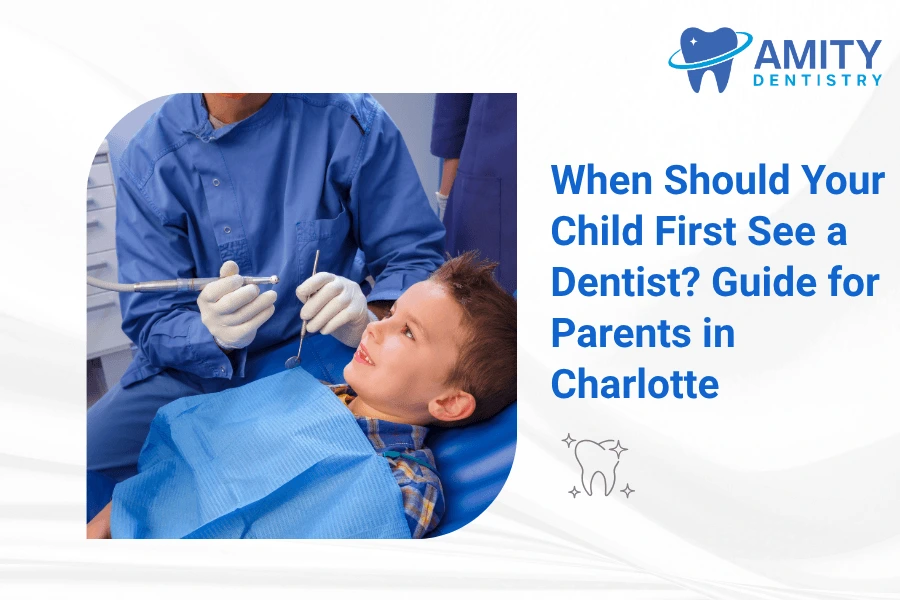
The dentist examines the teeth that have erupted, checks the gums, evaluates jaw development, and looks for any early signs of decay or structural concerns. For very young children, this is often done with the child sitting in the parent’s lap facing the dentist, keeping the child close to a familiar person while the dentist works.
2. Guidance on Home Care
Parents leave the first visit with concrete guidance on how to clean an infant’s mouth, when to introduce a toothbrush, what toothpaste to use and in what quantity, and how diet affects dental health in the early years. This guidance is calibrated to the child’s age and developmental stage, which changes significantly between twelve months and three years.
3. Setting the Recall Schedule
Based on the examination findings and risk assessment, the dentist establishes a recall schedule. Low-risk children typically return every six months. Higher-risk children, those with early decay indicators, certain feeding habits, or family history of dental problems, may be seen more frequently.
Key Developmental Windows and What to Watch For
Different ages carry different dental milestones and different risk profiles. Understanding what is normal and what warrants attention at each stage helps parents stay ahead of problems.
1. Six to Twelve Months
The lower central incisors typically appear first, followed by the upper central incisors. Teething discomfort is normal. Fever, however, is not caused by teething and a child with fever during this period should be seen by a pediatrician. As soon as the first tooth appears, it is susceptible to decay. Begin cleaning it with a soft damp cloth or infant toothbrush twice daily.
2. Twelve to Twenty-Four Months
By around age two and a half, most children have their full set of twenty primary teeth. Primary teeth matter. They hold space for permanent teeth, support speech development, and allow normal chewing. Early decay in primary teeth can affect the permanent teeth developing underneath them. The habit of brushing twice daily should be fully established by this stage, with a rice-grain amount of fluoride toothpaste for children under two.
3. Two to Four Years
This period is when thumb-sucking, pacifier use, and prolonged bottle or sippy cup use can begin to affect tooth alignment. Most habits self-resolve if discontinued before age three without lasting dental consequences. Persistent habits beyond age four can cause the upper front teeth to protrude and affect jaw development. The dentist can advise on the appropriate point to address specific habits based on the child’s development.
This is also the period when early childhood caries is most common, particularly in children who go to bed with bottles or who consume high-sugar diets. Early childhood caries can progress rapidly in primary teeth, which have thinner enamel than permanent teeth. A cavity identified at a routine visit at this age is a minor intervention. The same cavity identified a year later may require more significant treatment.
4. Four to Six Years
Children in this age group can begin developing basic toothbrushing techniques, though they still need parental supervision and assistance. Motor skills at this age are not developed enough for children to clean effectively on their own. A useful benchmark is that children who cannot tie their own shoelaces cannot brush their own teeth adequately.
The first permanent molars typically arrive around age six, erupting behind the existing primary teeth. These molars are permanent teeth that will need to last a lifetime, and they erupt without a primary tooth falling out first, which means parents often do not notice them. The dentist checks for these at routine visits and often applies dental sealants to protect the deep grooves of these molars from decay shortly after they erupt.
5. Six to Twelve Years
This is the period when primary teeth are lost and replaced by permanent teeth in sequence. The process is largely predetermined by genetics and timing varies significantly between children. The dentist monitors the sequence of eruption, checks for crowding or spacing issues, and evaluates whether orthodontic referral is appropriate.
Orthodontic assessment does not always mean immediate treatment. Early assessment, typically around age seven as recommended by the American Association of Orthodontists, identifies issues that benefit from early intervention versus those that are better addressed once the permanent dentition is more complete. The dentist is usually the first to identify these issues at routine visits.
When Should Your Child First See a Dentist?
Common Early Childhood Dental Issues: Parents Concerns
Charlotte is not unusual in its pediatric dental challenges. The issues that bring families into the chair most often are consistent with national patterns.
1. Early Childhood Caries
Tooth decay in infants and toddlers, often called baby bottle tooth decay, is the most common chronic childhood disease in the United States. It is also largely preventable. The combination of frequent sugar exposure, inadequate home cleaning, and infrequent dental visits creates the conditions for rapid decay in primary teeth. Early visits catch the early signs before cavities form.
2. Dental Anxiety
Children who first visit a dentist when something hurts are far more likely to develop dental anxiety that persists into adulthood. Establishing dental visits as routine from infancy, in a practice that handles young patients well, is the most effective prevention for dental anxiety. A child who associates the dentist with a familiar, calm environment approaches dental care very differently from one whose first experience was an emergency.
3. Thumb-Sucking and Pacifier Habits
These are normal in infancy and early toddlerhood. They become a dental concern when they persist beyond age three to four. The dentist monitors their effect on tooth alignment and jaw development at routine visits and advises on timing for habit cessation based on what is actually observed rather than general guidelines alone.
4. Tongue Tie
Ankyloglossia, commonly called tongue tie, is identified in infancy and can affect feeding, speech, and oral development. A dentist familiar with pediatric oral anatomy checks for this at early visits. When identified early, intervention is straightforward. When it goes undetected into later childhood, the secondary effects on speech and oral function are more complex to address.
Pediatric Dental Care in Charlotte: Why Early Dental Care Is Critical
What to Look for in a Pediatric Dentist in Charlotte
Not all dental practices are equally equipped for young patients. A few specific factors make a meaningful difference for children.
1. Child-Focused Environment
A practice that regularly sees young patients designs its environment and approach around them. The waiting area, the communication style, the pace of appointments, and the way the team interacts with anxious children all reflect whether a practice is genuinely child-focused or simply willing to see children alongside an adult caseload.
2. Experience with Behaviour Management
Young children do not always cooperate with dental examinations. An experienced pediatric dental team has a range of techniques for helping children through appointments without creating traumatic associations. This includes communication approaches, distraction techniques, and the patience to work at a child’s pace. Practices experienced with young patients rarely require children to simply endure an appointment through adult pressure.
3. Preventive Orientation
The best pediatric dental practices in Charlotte are prevention-focused. They invest time in parent education at early visits, apply sealants and fluoride treatments at appropriate developmental stages, and identify risk factors early rather than waiting for problems to present. A practice that emphasises prevention produces children who need less treatment.
Kid Friendly Pediatric Dentistry in Charlotte
Kids Dental Care with Amity Dentistry
A child who sees the same dentist or dental team across multiple years builds a relationship that makes each visit easier. Amity Dentistry in Charlotte provides pediatric dental care with an approach built around early intervention, parent education, and creating positive dental experiences for children from their first visit. The practice handles the full developmental arc from infant first visits through adolescent orthodontic monitoring, maintaining continuity of care across the years when dental foundations are established.