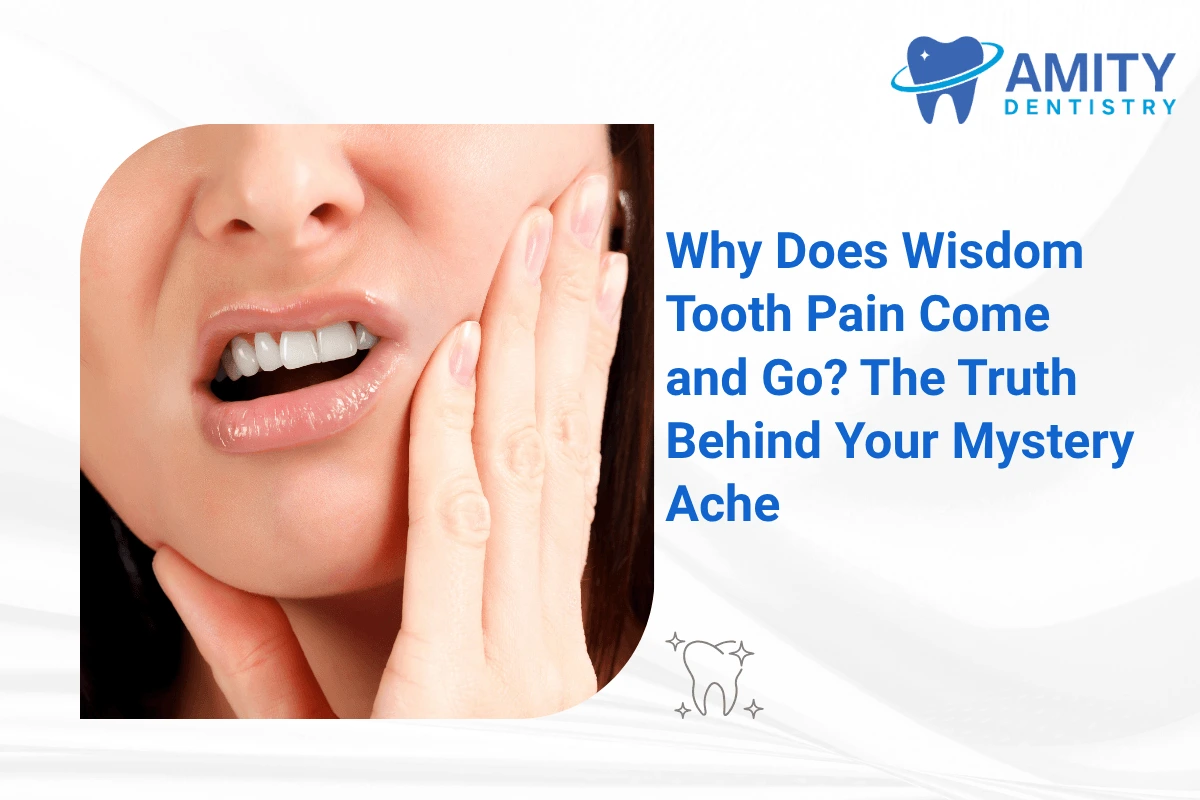
You wake up on a Tuesday with a dull throb at the back of your jaw. By Thursday, it is gone. You forget about it entirely, eat a sandwich on Saturday, and suddenly it is back with a vengeance. By Monday, there is no pain or swelling. It’s complete silence from the back of your mouth.
And so you do what most people do. You decide it has probably sorted itself out, make a mental note to mention it at your next check-up, and get on with your life.
Here is the thing: wisdom tooth pain that comes and goes is not resolving itself. It is cycling. The underlying issue is still there. The ache is just taking breaks between rounds, and at some point, it will stop taking breaks.
Key Takeaways: Why Does Wisdom Tooth Pain Come and Go
What Actually Is Wisdom Tooth Pain?
Wisdom tooth pain is not simply “a toothache at the back of your mouth.” From a dentist’s perspective, it is usually pain caused by inflammation, pressure, or infection around a third molar that does not have enough room to erupt normally. Rather than coming from the tooth itself, the discomfort often originates in the surrounding gum tissue, jawbone, or neighbouring teeth. The most common diagnosis is pericoronitis, where bacteria and food become trapped beneath a flap of gum over a partially erupted wisdom tooth, leading to recurring inflammation.
In the United States, wisdom tooth pain is often aggravated by everyday habits such as delayed dental check-ups, inadequate cleaning around partially erupted molars, smoking or vaping leading to poor oral health, teeth grinding (bruxism) habits, and diets high in sugary or sticky foods that increase the risk of decay. Especially in Charlotte, NC, where many patients balance busy work schedules and postpone treatment until the pain becomes severe, we frequently see wisdom teeth that have progressed from occasional irritation to active infection. Warm, humid weather can also make existing gum inflammation feel more uncomfortable, while seasonal allergies and sinus pressure sometimes cause patients to mistake upper wisdom tooth pain for sinus-related discomfort.
Why Does the Wisdom Tooth Pain Come and Go?
This is the part most people want answered. The cyclical nature of wisdom tooth pain is not random. It has specific causes, and most of them involve the same underlying mechanism playing out in stages.
1. Partial Eruption and the Gum Flap Problem
The most common reason for wisdom tooth pain cycles is partial eruption. The tooth breaks through the gum surface but does not fully emerge. This leaves a flap of gum tissue, called the operculum, sitting over part of the tooth.
That flap is a trap. Food, bacteria, and debris collect underneath it constantly. The immune system responds, inflammation builds, and the area becomes sore. Then the body clears the debris, or the swelling subsides, the inflammation reduces, and the pain disappears. Until the next time something gets stuck underneath. Which happens again. And again.
This condition is called pericoronitis, and it is the single most common cause of the on-again-off-again wisdom tooth ache.
2. Pressure from an Impacted Tooth
When a wisdom tooth is impacted, it is blocked from fully erupting, typically by the tooth in front of it or by the jawbone itself. An impacted tooth does not just sit quietly. It pushes. The pressure that creates can be intermittent, particularly if the tooth is still moving slowly, and it can cause pain that radiates far from the back of the jaw. Some people feel it in their ear, their temple, or along the jaw toward the front of the mouth. Others get headaches that do not connect to their teeth at all.
The pain cycles because the pressure is not constant. It eases, returns, and eases again as the tooth continues its slow, unsuccessful attempt to emerge.
3. Secondary Decay in a Hard-to-Clean Tooth
Wisdom teeth are at the back of the mouth in positions that are difficult or impossible to clean properly. Even in people who brush and floss thoroughly, the third molar is often partially out of reach. Decay develops on the tooth itself or on the back surface of the molar in front, and early decay is intermittently sensitive rather than continuously painful.
Heat, cold, sugar, and pressure cause spikes of discomfort that then subside once the stimulus is removed. It does not feel like a classic toothache. It feels like a vague complaint that flares occasionally and then disappears.
4. Cyst Formation Around the Tooth
In some cases, particularly with impacted wisdom teeth that have been left in place for years, a fluid-filled cyst can form around the tooth in the jawbone. These cysts are usually painless at first but can cause intermittent aching as they slowly expand. They can also damage the roots of neighbouring teeth and, over time, weaken the jawbone itself.
This is the scenario that makes dentists most emphatic about monitoring wisdom teeth that are not causing obvious acute pain. Intermittent discomfort with no obvious cause deserves an X-ray, not a wait-and-see.
Other Symptoms That Show Up Alongside the Pain
The ache is usually the main event, but wisdom tooth problems tend to travel with company. Watch for:
- Swelling in the gum at the back of the mouth, particularly around the site of a partially erupted tooth
- Bad taste or bad breath that does not resolve with brushing, caused by bacteria under the gum flap or around a decaying tooth
- Jaw stiffness or difficulty opening your mouth fully, which can indicate that pericoronitis has progressed to involve the surrounding tissue
- Pain felt in the ear, temple, or along the jaw on one side
- Sensitivity to temperature in the general area of the back teeth, particularly if hot or cold triggers a prolonged reaction rather than a brief twinge
- Swollen lymph nodes in the neck or jaw area, which indicate the body is responding to an infection
- Headaches on one side, recurring and not responding to standard pain relief
None of these individually confirms a wisdom tooth problem. But several of them together, combined with intermittent back-of-jaw aching, point strongly in that direction.
Experiencing strong wisdom tooth pain in Pineville, Charlotte, NC?
Don’t wait. Dr. Arati Shrestha and the Amity Dentistry team provide same-day evaluations for urgent wisdom tooth pain in Pineville, Charlotte.
What Happens If You Leave Wisdom Tooth Pain
The cycling nature of wisdom tooth pain creates a reasonable-sounding excuse to do nothing. It went away. It usually comes back milder. Maybe it will just resolve.
It does not resolve. Here is what tends to happen instead:
- Pericoronitis progresses. What starts as localised inflammation under a gum flap can spread to the surrounding tissue and, in serious cases, to the throat and neck. Dental infections that spread are a genuine medical emergency, not a dental inconvenience.
- The adjacent tooth gets damaged. An impacted wisdom tooth that is pushing against the second molar can cause root resorption, meaning the pressure actually dissolves the root of the neighbouring tooth. That tooth can then require treatment or extraction itself.
- Cysts grow. A small, asymptomatic cyst becomes a larger one. Larger cysts can require more complex surgery to address.
- Extraction becomes more complicated. Wisdom teeth are generally easier to remove in younger patients, before the roots are fully formed and the bone is less dense. Waiting until acute infection or significant impaction makes the procedure more involved, the recovery longer, and the risk of complications higher.
The dentists who say “let’s keep an eye on it” are not wrong in every case. Some wisdom teeth can reasonably be monitored. But monitoring means actual X-rays at actual appointments, not mentally noting that the ache went away.
When You Should See a Dentist for Wisdom Tooth Pain
The honest answer is that intermittent wisdom tooth pain is reason enough to get an appointment. But if you need a more specific list:
- The pain has been cycling for more than a few weeks
- You notice swelling, even mild swelling, around the back of the jaw
- You have had even one episode of jaw stiffness or difficulty opening your mouth
- The pain has ever woken you up at night
- You notice any bad taste or persistent bad breath
- You cannot remember the last time you had a dental X-ray
An X-ray, specifically a panoramic X-ray that shows the full position of the wisdom teeth in the jaw, changes the conversation. Instead of guessing what is causing the pain, your dentist can see exactly where the tooth is, whether it is impacted, whether there is any cyst formation, and what effect it is having on the teeth around it.
That information makes the decision clear. Whether it is monitoring, a referral, or extraction, you are acting on evidence rather than trying to interpret whether Tuesday’s ache was worse than last month’s.
Detail Guide: When to See a Dentist for Wisdom Tooth Pain
Why Amity Dentistry in Pineville, Charlotte
At our dentistry in Pineville, Charlotte, we see wisdom tooth concerns regularly, and the patients who come in early almost always have more options than the ones who come in when it has become genuinely acute.
We take the time to explain what we are seeing on imaging, walk you through the options without pressure, and help you make a decision that makes sense for your specific situation. Not every wisdom tooth needs to come out immediately. But every wisdom tooth causing intermittent pain deserves a proper look.
If the ache at the back of your jaw has been showing up and disappearing for a while, that is reason enough to come in. It is a short appointment. It is a lot shorter than the alternative.
Book an appointment or ask our team a question directly at Amity Dentistry, Pineville.