Dental pain has a particular quality that makes it difficult to ignore and difficult to assess accurately. A toothache that starts on a Friday evening raises an immediate question: is this something that needs attention tonight, or can it wait until Monday morning? The wrong answer in either direction has consequences. Dismissing a genuine emergency allows a condition to progress that was containable at the point it presented.
Understanding Same Day Dentist Appointment Needs
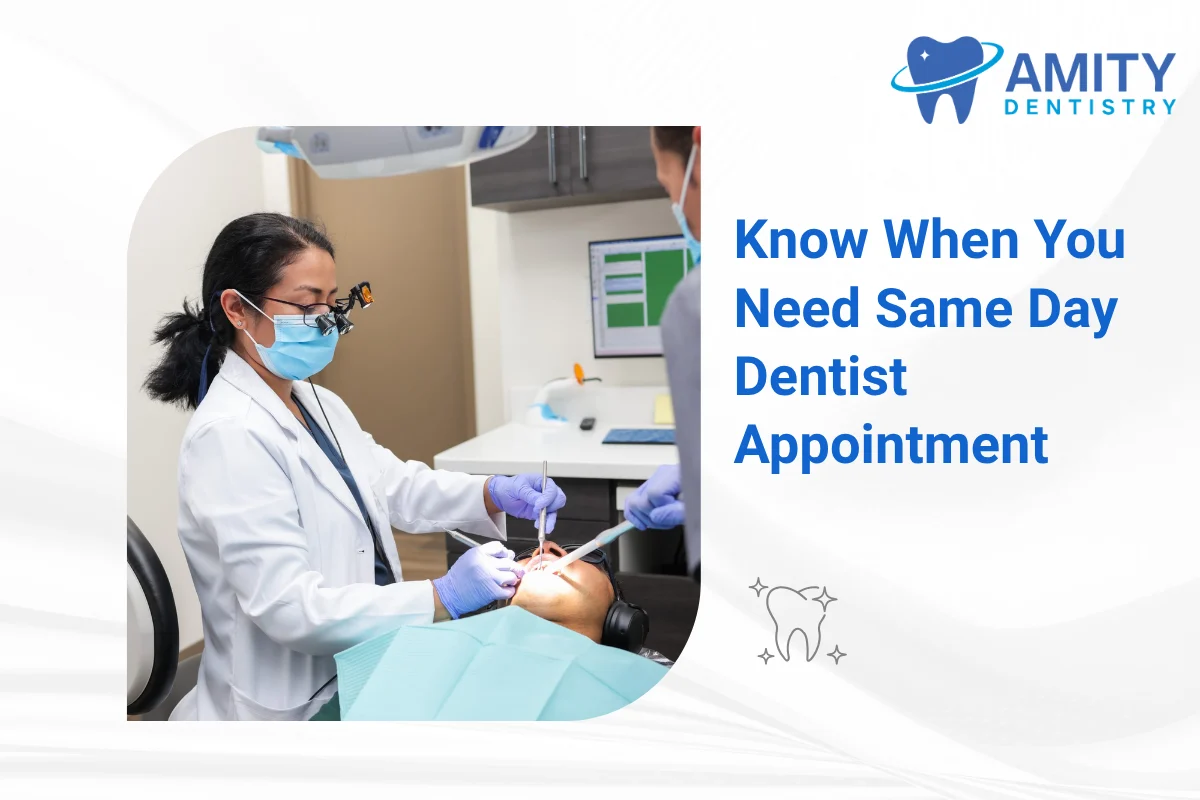
Not every dental problem requires emergency care, but certain conditions demand same day dentist appointment to prevent serious complications. For over 15 years, we have been providing patients with pain relief and treatment as their emergency dentist in Charlotte. Throughout that time we understood what a patient needs to know regarding dental emergencies. Knowing the difference helps you respond appropriately when dental pain strikes at inconvenient times.
This dental guide covers:
- True dental emergencies: dental abscesses with swelling, knocked-out permanent teeth, severe fractures, uncontrolled bleeding, and conditions threatening your overall health
- What can wait for a scheduled appointment: mild toothaches, small chips without pain, lost fillings with minimal discomfort
- Warning signs that escalate any problem: facial swelling, fever, difficulty breathing or swallowing, severe uncontrolled pain
- Home management before reaching the dentist: pain relief strategies, proper tooth storage, bleeding control techniques
Understanding what qualifies as a genuine emergency allows you to seek appropriate care at the right time, avoiding both unnecessary after-hours costs and dangerous delays in treatment.
What Truly Counts as a Dental Emergency
A dental emergency is any situation where delay in treatment will result in significantly worse outcomes, whether that means spreading infection, permanent tooth loss, uncontrollable pain, or risk to overall health. The category is not defined by pain intensity alone. Some serious conditions present with mild discomfort initially. Some non-emergencies are extremely painful. A same day dentist appointment is suggested for serious dental conditions.
Conditions That Require Same Day Dentist Appointment
1. Dental Abscess
An abscess is a bacterial infection that has progressed to the point of forming a pocket of pus, typically at the root of a tooth or in the gum tissue beside it. The defining characteristic is swelling, which may be visible in the face, jaw, or neck. An abscess does not resolve without treatment. The infection can spread to adjacent structures including the jaw, neck, and in serious cases the airway and bloodstream, a condition called Ludwig’s angina that is life-threatening. If you have facial swelling alongside tooth pain, this is an emergency.
Symptoms of an abscess include:
- Severe, throbbing toothache that may radiate to the jaw, ear, or neck
- Visible swelling in the face, cheek, or gum
- Fever
- Sensitivity to hot and cold that persists after the stimulus is removed
- A pimple-like bump on the gum near the affected tooth that may discharge a bitter-tasting fluid
- Difficulty swallowing or breathing in severe cases, which warrants an emergency room visit rather than a dental office
2. Knocked-out Permanent Tooth
A tooth that has been completely displaced from its socket has the best chance of successful reimplantation if it is replaced or preserved correctly within 30 to 60 minutes. After an hour out of the socket, the periodontal ligament cells on the root surface that allow reimplantation to succeed begin to die. Time is the critical variable.
If a permanent tooth is knocked out:
- Handle it by the crown only, not the root
- If it is dirty, rinse briefly under clean water without scrubbing
- Reinsert it into the socket if possible and bite down gently on gauze or a clean cloth to hold it
- If reinsertion is not possible, store it in milk, saline, or between the cheek and gum to keep it moist
- Get to a dentist immediately
Primary teeth, baby teeth, are not reimplanted because doing so can damage the developing permanent tooth beneath. A knocked-out primary tooth is not a dental emergency in the same sense, though prompt assessment is still appropriate.
3. Cracked or Fractured Tooth with Pain
A crack that extends below the gum line or into the pulp causes significant pain and requires urgent treatment. Cracks of this severity cannot be managed at home and will worsen under chewing forces. A crack limited to the enamel surface with no pain is not an emergency, though it warrants prompt evaluation.
4. Soft Tissue Injuries
Lacerations to the lips, tongue, or gums that are bleeding heavily and not responding to pressure need attention. Significant soft tissue trauma may require suturing. Apply firm, continuous pressure with clean gauze for 15 to 20 minutes. If bleeding does not slow, proceed to an emergency dentist or emergency room.
5. Lost or Broken Restoration
A crown or filling that has come out leaving the underlying tooth structure exposed can cause significant pain from temperature and pressure sensitivity and leaves the tooth vulnerable to fracture and decay. Same-day attention prevents a manageable restorative problem from becoming a more complex one.
Conditions That Can Wait for a Scheduled Appointment
Not every dental problem that causes discomfort requires emergency care. Identifying what does not qualify as an emergency allows you to avoid unnecessary out-of-hours visits while ensuring genuine emergencies are treated with appropriate urgency.
The following typically do not require same-day emergency care:
- A broken tooth with no pain and no sharp edges causing soft tissue irritation
- A lost filling or crown with mild sensitivity but no pain at rest
- Mild, intermittent toothache without swelling or fever
- A chipped tooth that is not causing pain
- Orthodontic wire irritation without puncture injury
- Mild gum soreness without swelling
These conditions warrant a prompt appointment within a day or two but are not emergencies in the clinical sense. Calling your dental practice and describing the symptoms accurately allows the reception team to triage appropriately and find the soonest available slot.
Warning Signs That Escalate Any Dental Problem to an Emergency
Certain symptoms, when present alongside any dental problem, indicate that what started as a routine issue has progressed to an emergency:
- Facial swelling, particularly if it is spreading or affecting the eye or neck
- Fever in combination with dental pain
- Difficulty swallowing or breathing
- Bleeding that does not slow after 20 minutes of firm pressure
- Numbness in a tooth or the surrounding area that appeared suddenly without anaesthesia
- Severe, uncontrolled pain that is not responding to over-the-counter pain relief
Any of these in combination with dental symptoms moves the situation into same-day emergency territory. Facial swelling with difficulty swallowing is a medical emergency that may require an emergency room rather than a dental office.
What to Do Before You Reach the Dentist for Dental Emergency
Managing symptoms while arranging emergency care reduces discomfort and in some cases limits the progression of the condition.
For pain:
- Ibuprofen at the recommended dose is more effective than paracetamol for dental pain because it addresses both pain and inflammation. Take it with food.
- Do not place aspirin directly against the gum tissue. It does not provide topical relief and causes chemical burns to the soft tissue.
- Clove oil applied to the affected area with a cotton ball provides temporary topical anaesthesia from eugenol. It is available at pharmacies.
- Cold packs applied to the outside of the face in 20-minute intervals reduce swelling and provide mild pain relief.
For a knocked-out tooth:
- Time and correct storage are the critical variables. Follow the steps described above and call ahead so the practice can prepare for reimplantation on arrival.
For a dental abscess:
- Do not apply heat to the area. Heat increases blood flow to the infection and can accelerate spreading.
- Rinsing with warm salt water provides mild relief and helps keep the area clean.
- Over-the-counter pain relief manages symptoms but does not treat the infection. Antibiotic treatment requires a prescription and is part of the clinical management, not a substitute for drainage of the abscess.
For bleeding soft tissue injuries:
- Apply firm, continuous pressure with clean gauze or cloth.
- Do not repeatedly lift the gauze to check the wound, as this disrupts clot formation.
- If bleeding persists beyond 20 minutes of continuous pressure, seek emergency care.
Common Misunderstandings About Dental Emergencies
Several misconceptions cause people to either delay necessary care or seek emergency treatment for non-urgent situations.
“It will probably go away on its own.”
Dental infections do not resolve without treatment. A toothache that subsides after a few days without treatment most commonly indicates that the nerve has died, not that the problem has resolved. The infection may continue to progress in the absence of pain. Absence of pain is not absence of the problem.
“I’ll wait and see if it gets worse.”
With a knocked-out tooth, waiting costs the chance of successful reimplantation. With an abscess developing facial swelling, waiting allows the infection to spread. Some dental emergencies have narrow windows in which the best outcomes are achievable.
“Pain relief means I don’t need to go in.”
Over-the-counter pain relief manages symptoms. It does not treat the underlying condition. A dental abscess that stops hurting because the nerve has been destroyed by the infection is still an active infection requiring treatment.
“It’s just a baby tooth.”
Primary teeth that are abscessed, fractured into the gum, or causing significant swelling still require prompt assessment. An infected primary tooth can affect the developing permanent tooth beneath it and the surrounding bone.
Call Amity Dentistry: Same Day Dentist Appointment in Charlotte
Amity Dentistry provides same day dentist appointment in Charlotte for patients experiencing urgent dental situations. The practice prioritises same-day appointments for genuine emergencies and provides accurate triage over the phone to help patients determine the appropriate urgency of their situation. The clinical team is equipped to manage dental abscesses, tooth reimplantation, fracture assessment, and soft tissue injuries with the same standard of care applied to scheduled appointments.
If you are unsure whether your situation constitutes a dental emergency, call the practice directly and describe your symptoms. Accurate symptom description over the phone allows the team to advise on urgency, provide interim management guidance, and prepare for your arrival where same-day care is required.
Whether you’re in South Charlotte dealing with a knocked-out tooth or in Pineville with a dental abscess, contact Amity Dentistry first for guidance. We provide same-day emergency appointments when available. Call 980-423-1244 and Book Now.