Tooth extraction is not a failure of dental care. It is a clinical decision that becomes the right one when keeping a tooth creates more harm than removing it. When the cost and complexity of saving the tooth is disproportionate to the benefit, or when the tooth is causing active damage to adjacent structures. At Amity Dentistry, we serve patients throughout the Charlotte metro area, including Pineville, providing comprehensive extraction services and replacement planning.
Tooth extraction becomes necessary when preserving a tooth creates more harm than removing it. This guide explains when is tooth extraction necessary and what to expect throughout the process.
You’ll learn about:
- When extraction is recommended: severe decay beyond restoration, advanced gum disease, failed root canal treatment, impacted wisdom teeth, and orthodontic planning
- The extraction procedure: differences between simple and surgical extractions, what happens during the appointment, and anesthesia options
- Recovery and aftercare: managing discomfort, preventing dry socket, and understanding the healing timeline
- Replacement options: dental implants, bridges, and dentures to restore function and prevent bone loss
Understanding why extraction is recommended, what the procedure involves, and what the options are for replacing the extracted tooth allows patients to make informed decisions rather than simply accepting or resisting a recommendation they do not fully understand.
When is Tooth Extraction Necessary: 5 Situations for a Tooth Extractions
1. Severe Decay Beyond Restoration
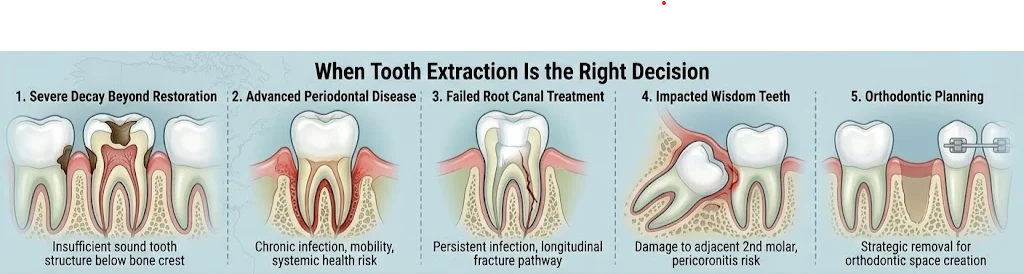
Tooth decay that has progressed through the enamel and dentine into the pulp, and that has destroyed enough of the tooth structure to make a reliable restoration impossible, leaves extraction as the remaining option. The threshold for this decision is not arbitrary. It is based on how much sound tooth structure remains to support a restoration, whether the root and surrounding bone are adequate for a crown, and whether the infection, if present, can be resolved through root canal treatment.
A tooth that has lost significant coronal structure to decay but retains sound roots and adequate bone support may still be saveable through root canal treatment followed by a post, core, and crown. A tooth where decay has extended below the bone level on multiple surfaces, or where the remaining structure is insufficient to retain any restoration reliably, has crossed the threshold at which restoration is no longer a realistic option.
The clinical assessment involves:
- Periapical X-ray to assess root length, bone level, and the extent of periapical pathology
- Clinical probing to determine the depth of decay relative to the bone crest
- Assessment of remaining tooth structure above the bone level
- Evaluation of whether endodontic treatment is viable and whether the tooth can be restored after it
When this assessment produces a picture where restoration is technically possible but unlikely to be durable or cost-effective, the recommendation shifts to extraction and replacement planning.
2. Advanced Periodontal Disease
Periodontal disease destroys the bone and connective tissue that anchor the tooth in the jaw. In its advanced stages, bone loss reaches a point where the tooth has insufficient support to function under normal chewing forces. The tooth becomes mobile, the surrounding tissue is chronically infected, and the ongoing infection affects adjacent teeth and supporting structures. A periodontal dental check-ups is adviced every 3 to 6 months depending on the severity of the gum condition during the last dentist visit.
Extraction of a tooth with advanced periodontal bone loss is indicated when:
- Bone loss has reached a level where the tooth cannot be stabilised through periodontal treatment
- The tooth is significantly mobile and cannot be used for chewing
- The ongoing infection is contributing to periodontal destruction of adjacent teeth
- The patient’s systemic health is being affected by the chronic infection load
Periodontal disease that has affected multiple teeth creates complex extraction and replacement planning scenarios. The sequence of extractions, the condition of remaining teeth, and the options for replacement all need to be mapped before extraction proceeds to ensure the treatment plan produces a functional and aesthetic outcome.
3. Failed Root Canal Treatment
Root canal treatment has a high success rate but is not universally successful. A tooth that has undergone root canal treatment and subsequently develops persistent infection, symptomatic apical pathology, or a root fracture that cannot be managed through retreatment or surgical intervention has reached the end of its viable treatment pathway.
Root fracture is one of the most common causes of failed root canal teeth requiring extraction. A vertical root fracture, where the root splits longitudinally, creates a persistent bacterial pathway along the fracture line that cannot be sealed. The tooth cannot be saved. Extraction and replacement planning is the clinical response.
Before recommending extraction of a previously root canal treated tooth, the clinician should assess:
- Whether retreatment is feasible and has a reasonable prognosis
- Whether surgical endodontic treatment such as an apicoectomy is an option
- Whether the fracture pattern rules out both of these options
A tooth that has exhausted non-surgical and surgical endodontic options, or where the cost and complexity of further intervention is disproportionate to the expected lifespan of the tooth, is a clear candidate for extraction.
4. Impacted Wisdom Teeth
Third molars, wisdom teeth, frequently lack the space to erupt fully into a functional position. Partial eruption creates a persistent opening in the gum tissue around the tooth where bacteria accumulate and infection, called pericoronitis, recurs. Fully impacted wisdom teeth that remain below the gum line can cause pressure damage to adjacent second molars, contribute to the development of cysts, or create radiographic changes in the surrounding bone that warrant removal. Wisdom tooth pain can be serious case for some and should seek an appointment with a dentist quickly.
Not all impacted wisdom teeth require extraction. The decision is based on:
- Whether the impacted tooth is causing or likely to cause damage to adjacent teeth
- Whether pericoronitis is recurrent or severe
- Whether there is radiographic evidence of pathology associated with the impacted tooth
- The patient’s age, as wisdom tooth extraction in younger patients involves less complex surgery and faster healing than extraction in older patients where root development is complete and bone density is higher
Asymptomatic (having an illness or infection but presenting with no signs or symptoms), fully impacted wisdom teeth in older patients that show no radiographic pathology and no risk to adjacent teeth are sometimes monitored rather than removed, as the surgical risk and recovery in older patients may outweigh the benefit of prophylactic removal.
5. Orthodontic Treatment Planning
Extraction is sometimes part of a planned orthodontic treatment sequence rather than a response to pathology. When the dental arch lacks the space to accommodate all teeth in correct alignment, strategic extraction of specific teeth, most commonly premolars, creates the space into which the remaining teeth are moved during orthodontic treatment.
Orthodontic extraction decisions are made as part of a comprehensive treatment plan and are typically:
- Planned well in advance of active orthodontic treatment
- Specific about which teeth are extracted based on the space requirement and movement plan
- Coordinated with the timing of appliance placement
Types of Tooth Extraction Procedure that Dentist Follow
1. Simple Tooth Extraction
A simple extraction is performed on a tooth that is fully erupted and accessible in the mouth. Local anaesthesia is administered to the area around the tooth, which numbs the tooth, surrounding gum, and adjacent bone. Once anaesthesia is established, the tooth is loosened using an instrument called an elevator that expands the socket and severs the periodontal ligament fibres attaching the tooth to the bone. Forceps then deliver the tooth from the socket.
Simple extractions are well-tolerated procedures. Patients feel pressure and movement but not pain. The anaesthetic blocks pain signals while allowing proprioceptive sensations, which is why the procedure feels physically significant despite being comfortable.
2. Surgical Tooth Extraction
Surgical extraction is required when the tooth is not accessible through a simple approach. This includes:
- Impacted teeth that are partially or fully below the gum line
- Teeth with curved, dilacerated, or hypercementing roots that cannot be removed intact
- Teeth that fracture during extraction leaving root fragments requiring surgical retrieval
- Teeth where the crown has broken down to gum level leaving only the root
Surgical extraction involves an incision in the gum tissue to expose the tooth and surrounding bone, bone removal in some cases to access an impacted tooth, and sectioning of the tooth into multiple pieces to allow removal through a smaller space than the intact tooth would require. The site is closed with sutures after extraction.
Tooth Extraction Aftercare: Managing Recovery and Planning Replacement
Recovery from a straightforward extraction follows a predictable course. A blood clot forms in the socket within the first few hours and begins the healing sequence. The first 24 to 48 hours involve the most significant discomfort, managed with ibuprofen and paracetamol on a rotating schedule. Swelling peaks at 48 to 72 hours and then resolves progressively.
Dry socket, the most common post-extraction complication, occurs when the blood clot is dislodged or fails to form, leaving the socket bone exposed. It causes a distinctive deep, radiating ache that develops three to four days after extraction rather than improving. It requires a return visit for dressing and management. Risk factors include smoking, use of straws, vigorous rinsing in the first 24 hours, and extraction of lower wisdom teeth.
The most important decision after extraction, other than immediate recovery, is replacement planning. A missing tooth creates several downstream consequences:
- Adjacent teeth drift toward the gap over time
- The opposing tooth over-erupts into the space
- Bone in the extraction site resorbs progressively without a tooth root to stimulate it
- Chewing efficiency decreases depending on the location of the extracted tooth
Replacement options include
- Dental implants, which replace both root and crown and preserve bone volume
- Fixed bridges, which anchor to adjacent teeth and span the gap
- Removable partial dentures, which replace multiple missing teeth with a removable appliance.
Each option has clinical indications, cost implications, and maintenance requirements that need to be discussed before extraction proceeds where possible, so the patient understands the full treatment pathway.
Emergency Tooth Extractions in Charlotte
Some extractions cannot wait for scheduled appointments. Emergency extraction becomes necessary when a tooth abscess causes severe swelling affecting breathing or swallowing, when trauma has fractured a tooth beyond repair, or when acute infection is spreading. Amity Dentistry provides emergency dental care for Charlotte communities like Pineville experiencing dental emergencies that require immediate extraction.
Choose Amity Dentistry for Tooth Extractions
Amity Dentistry provides tooth extractions in Pineville, Charlotte for patients across the full range of extraction indications, from straightforward single-tooth removal through to surgical extraction of impacted wisdom teeth. The practice approaches extraction as one component of a broader treatment plan that includes replacement planning and the management of adjacent teeth, rather than as an isolated procedure.
Patients are given a clear explanation of why extraction is recommended, what the alternatives are, when is tooth extraction necessary a0 nd what the replacement options look like before the procedure is scheduled. Contact Amity Dentistry to arrange an assessment if you have been told a tooth may need to be removed or if you are experiencing symptoms that may indicate a tooth cannot be saved.