The question comes up in almost every orthodontic consultation for adult patients. Both options move teeth. Both produce results. Both have been in clinical use long enough to have well-documented track records.
The honest answer is that neither is universally better. The right choice depends on the specific clinical situation, the patient’s lifestyle, their compliance patterns, and what they are willing to manage across a treatment period that runs anywhere from several months to two years.
This is a straightforward comparison of both options across the factors that actually determine the right choice for adult patients in Pineville.
How Invisalign vs Braces Work: Key Differences Explained
1. Invisalign
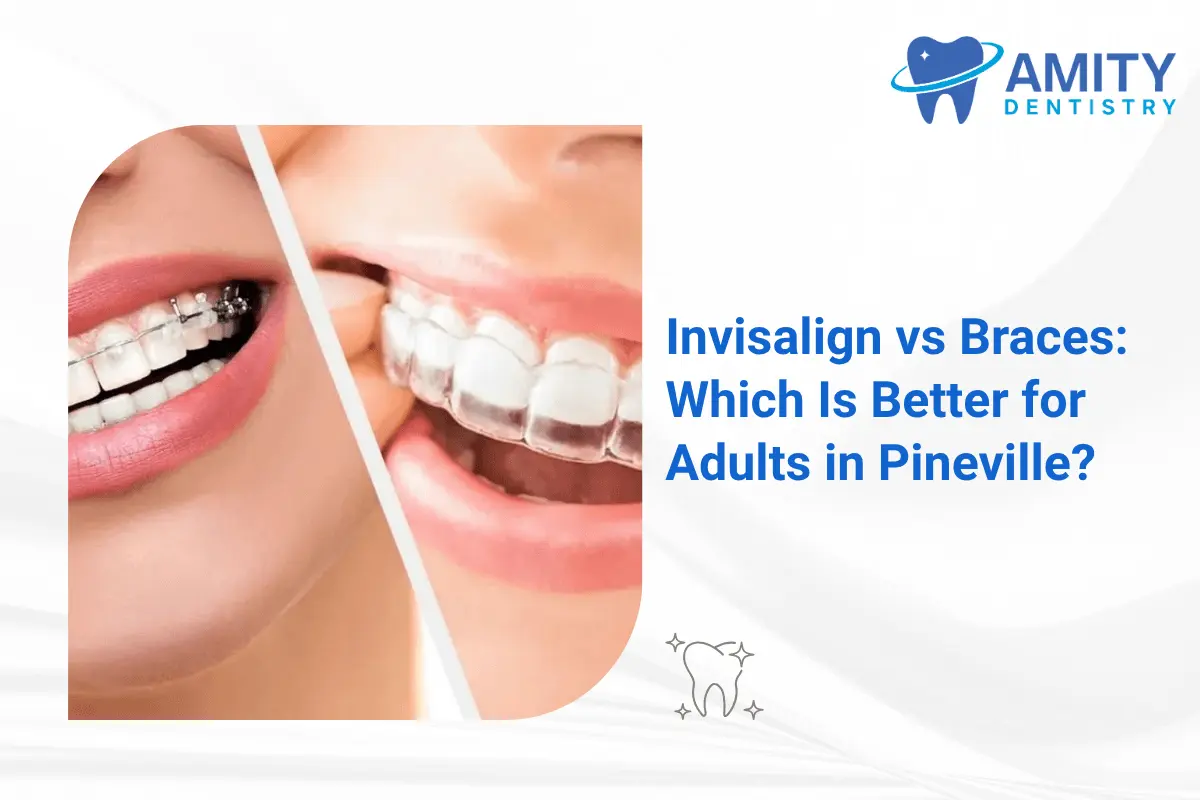
Invisalign uses a series of custom-fabricated clear thermoplastic aligners, each representing a small increment of planned tooth movement. The aligners are worn in sequence, each for one to two weeks, and the full series maps the complete treatment journey from current position to planned final position.
Small tooth-coloured composite attachments are bonded to specific teeth to provide the geometric features the aligner needs to apply force in directions that smooth tooth surfaces cannot accommodate. The system is removable for eating, drinking, and cleaning.
2. Traditional Braces
Traditional braces bond metal or ceramic brackets directly to each tooth and connect them with an archwire that applies continuous force across the full arch. The orthodontist or dentist adjusts the wire tension at periodic appointments, progressively increasing the force in the direction of planned movement.
Ceramic brackets use tooth-coloured materials rather than metal, making them less visible while retaining the fixed appliance mechanics. The system is fixed and cannot be removed by the patient.
Invisalign vs Braces Visibility: Which Is More Discreet for Adults?
For most adult patients, aesthetics is the primary driver of the Invisalign versus braces conversation. The prospect of wearing visible metal hardware through business presentations, client meetings, social events, and photographs is the reason many adults who needed orthodontic treatment in adolescence but did not have it are reconsidering in adulthood.
1. Invisalign
Clear aligners are not invisible. Under direct light or close observation, they are noticeable. But in normal social interaction, conversation, and professional settings, they are functionally imperceptible to most people. Patients regularly report that colleagues and friends were unaware they were in orthodontic treatment throughout their full Invisalign course.
2. Traditional Metal Braces
Metal braces are visible and noticeable. For adult patients in professional or client-facing roles, this visibility is a genuine consideration rather than a vanity concern. The metal hardware affects how patients present themselves in contexts where appearance matters professionally.
3. Ceramic Braces
Ceramic brackets offer a middle ground. The bracket body is tooth-coloured, significantly reducing visibility compared to metal. The archwire connecting them is often still metallic, though white-coated wire options exist. Ceramic braces are more visible than Invisalign but substantially less visible than metal.
Verdict: For adult patients whose primary concern is treatment visibility in professional and social contexts, Invisalign provides the most discreet experience. Ceramic braces offer a compromise. Metal braces are the most visible option.
Invisalign vs Braces Effectiveness: Which Works Better for Your Case?
This is where the comparison becomes more nuanced and where clinical assessment rather than patient preference should lead the decision.
Where Invisalign Performs Strongly
- Mild to moderate crowding and spacing
- Overbite correction in cases within the aligner’s mechanical range
- Crossbite correction for teeth within accessible movement parameters
- Minor rotation of teeth with favourable geometry
- Cases where the full planned movement falls within what aligner mechanics can reliably achieve
Where Traditional Braces Have Advantages
- Severe crowding requiring significant arch development
- Complex rotation, particularly of round-rooted or conical teeth
- Precise torque control across multiple teeth simultaneously
- Significant vertical tooth movement
- Cases requiring coordinated movement of multiple teeth in complex sequences
- Skeletal discrepancies requiring tooth movement in conjunction with jaw positioning
The technology gap between Invisalign vs braces has narrowed considerably over the past decade. Cases that were outside the scope of clear aligner treatment ten years ago are now routinely managed with Invisalign in experienced hands. But the boundary still exists. A dentist who offers both modalities and assesses each patient’s case against the clinical requirements of both options is better placed to make an objective recommendation than one whose practice offers only one.
For adult patients with complex cases, the most aesthetically appealing option is not always the most clinically appropriate one. Understanding which system the specific case requires is the starting point of the conversation, not the endpoint.
Your Daily Wear Consistency Determines the Results
The single biggest difference between Invisalign vs braces for adult patients depends on consistency.
Traditional braces are fixed. The force driving tooth movement is applied continuously regardless of patient behaviour. The patient’s role is to attend adjustment appointments, maintain hygiene, and avoid foods that damage brackets. The mechanics of the treatment run whether the patient actively participates or not.
Invisalign is removable and the treatment only works when the aligners are in. The prescribed wear time is 20 to 22 hours per day. Each hour the aligner is out is an hour without the controlled force the treatment plan depends on.
What Poor Consistency Looks Like
- Aligners removed during work hours or social events regularly
- Wearing aligners for 14 to 16 hours rather than 20 to 22
- Extended removal for meals followed by delayed reinsertion
- Moving to the next aligner before the current one fits fully
The consequence of sustained poor consistency of wearing aligners is not just slower treatment. It is planned tooth movements that do not fully express, mismatches between where the teeth are and where the aligners expect them to be, and a requirement for refinement aligners to correct the shortfall. Some patients who expect a 14-month Invisalign course find themselves at 20 months with additional refinements because their consistency averaged 16 hours per day rather than 22.
Adult patients who are honest with themselves about their consistency of wearing the aligners make better treatment decisions. If travel, unpredictable schedules, or social settings make consistent 22-hour daily wear difficult to sustain, traditional braces may produce a more predictable outcome.
Oral Hygiene with Invisalign vs Braces: Which Is Easier to Maintain?
Oral hygiene management after orthodontic treatment is significantly different between the two systems.
Cleaning Teeth with Invisalign Aligners
Aligners are removed for cleaning. Brush and floss normally, clean the aligner tray, and reinsert. The full access to every tooth surface during cleaning makes maintaining oral hygiene during Invisalign treatment straightforward compared to fixed appliances. For adult patients who already maintain strong hygiene habits, Invisalign adds minimal complexity to their routine.
Oral Hygiene Challenges with Braces
Brackets and wires create multiple surfaces that trap food and plaque. Cleaning around brackets requires interdental brushes, floss threaders, or water flossers to access areas that standard brushing cannot reach.
Patients who do not adapt their hygiene routine to the demands of fixed appliances accumulate plaque around brackets that leads to decalcification, the white spot lesions that appear on enamel after bracket removal in patients who did not clean adequately during treatment.
Adult patients with existing gum disease or a history of decay have a stronger hygiene argument for Invisalign. The ability to clean teeth fully without navigating around hardware reduces the risk of treatment-related oral health deterioration.
Comfort Comparison: Invisalign vs Braces Pain, Irritation & Adjustment
Traditional braces involve metal hardware that contacts the soft tissues of the lips, cheeks, and tongue. During the adjustment period and after wire changes, most patients experience irritation and ulceration of the soft tissue where it contacts brackets and wire ends. Orthodontic wax provides temporary relief but the irritation is a consistent feature of the treatment period for most patients with fixed appliances.
Invisalign aligners have smooth edges and no metal hardware. The primary discomfort is the pressure sensation that comes with each new aligner as it applies force to move teeth to the next position. This pressure typically resolves within 48 hours and is generally described as more manageable than the soft tissue irritation of fixed appliances.
For adult patients who are sensitive to physical discomfort or who are in roles where they speak extensively, the comfort difference between Invisalign and braces during the treatment period is a legitimate consideration.
Treatment Duration Comparison
Treatment length for both systems depends on case complexity rather than which system is used. The comparison is not straightforward because the same case may take slightly different timeframes depending on the mechanics of each system applied to the specific movements required.
General Timelines for Adults
- Minor cases: 3 to 6 months with either system
- Moderate cases: 12 to 18 months
- Comprehensive cases: 18 to 24 months or beyond
The practical difference in duration is that Invisalign timelines are more variable because they depend on compliance. A traditional braces case has a more predictable timeline because the mechanics run continuously. An Invisalign case with consistent 22-hour wear tracks closely to the planned timeline. One with variable compliance runs longer.
Adult patients with a specific endpoint in mind, a wedding, a major professional milestone, a defined personal deadline, benefit from discussing how realistic the timeline is for their specific case and compliance expectations at the consultation stage.
Invisalign vs Braces Cost Considerations
The cost of Invisalign and traditional braces varies depending on case complexity, the specific treatment plan, and the practice providing the treatment. As a general comparison, comprehensive Invisalign treatment is often priced at a premium over traditional metal braces for equivalent case complexity, reflecting the technology involved in digital planning and aligner fabrication. Ceramic braces typically sit between metal braces and Invisalign in cost.
For adult patients evaluating cost, the relevant comparison is not just the upfront price. Refinement aligners required due to compliance issues add to the Invisalign cost.
Extended treatment timelines from compliance shortfalls extend monitoring appointment requirements. Understanding the full cost picture including what happens if additional refinements are needed is part of the informed consent process.
Invisalign and Braces in Pineville: What to Expect at Your Consultation
The factors that point most strongly toward Invisalign are professional visibility concerns, strong compliance patterns and self-discipline, good existing oral hygiene, and a case that falls within the clinical range that clear aligner mechanics handle reliably.
The factors that point toward traditional braces are a complex case that requires fixed appliance mechanics, honest concerns about compliance with removable appliances, an existing hygiene challenge that fixed appliances would not meaningfully worsen, and a preference for a treatment that runs without depending on daily patient decisions.
Ceramic braces occupy the middle ground for patients who want reduced visibility without the compliance demands of Invisalign and whose case benefits from fixed appliance mechanics.
Amity Dentistry in Pineville, Charlotte NC provides both Invisalign and traditional braces for adult patients, with assessments that begin from the clinical requirements of the specific case rather than from a practice preference for one system. The consultation includes a digital scan, a review of the case complexity against the capabilities of both systems, and a clear explanation of what each option involves for the patient’s specific situation.