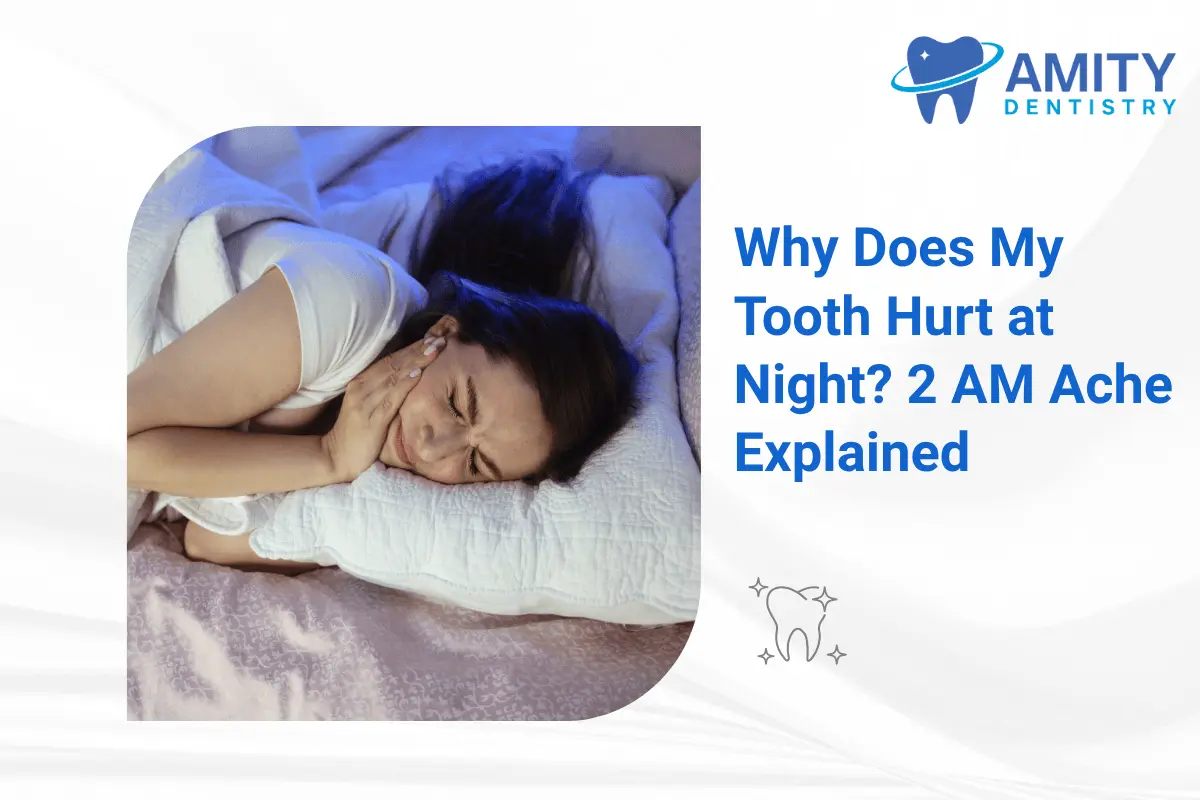
You were fine all day. Maybe a twinge here and there, easily ignored. Then you get into bed, and within twenty minutes, your tooth is throbbing in a way that makes sleep impossible. You are staring at the ceiling at 2 AM, wondering why the pain that was manageable at noon has become unbearable now that you are trying to sleep.
Quick Summary: Why Does My Tooth Hurt at Night More than Day-time?
- Tooth pain often worsens at night because lying down increases blood flow and pressure around inflamed teeth.
- Fewer distractions at bedtime make pain signals more noticeable and harder to ignore.
- Common causes of nighttime toothaches include:
- Tooth abscesses
- Deep cavities reaching the nerve
- Cracked teeth
- Gum disease
- Teeth grinding (bruxism)
- Exposed dentine and tooth sensitivity
- Temporary relief measures include:
- Sleeping with your head elevated
- Taking anti-inflammatory pain relief (as directed)
- Applying a cold compress
- Using clove oil for short-term numbing
- Rinsing with warm salt water
- Home remedies do not fix the underlying problem and should only be used until you can see a dentist.
- Seek urgent dental care immediately if tooth pain is accompanied by facial or gum swelling, fever, difficulty swallowing, severe throbbing pain that won’t subside
Key Takeaway: If your tooth consistently hurts more at night, it is usually a sign of inflammation, infection, or tooth damage that requires professional dental treatment.
Nighttime tooth pain is one of the more disorienting dental experiences precisely because the timing feels random. It is not. There are specific, well-understood reasons why a toothache at night is worse than during the day, and understanding them helps you take the right steps both in the moment and the following morning when you call the dentist.
Why Tooth Pain Gets Worse When You Lie Down
The most consistent reason a tooth hurts when you lie down is blood pressure and circulation. When you are upright during the day, gravity assists with blood drainage from the head and face. When you become horizontal, blood pressure in the vessels around the tooth increases. If there is already inflammation inside or around the tooth, that increased pressure amplifies the pain signal.
Think of it this way: an inflamed tooth that is already irritated becomes more irritated when more blood is pushed through the surrounding tissue with nowhere to drain as easily. The pain that was a 3 during the day becomes a 7 at night, not because the underlying problem has changed, but because your body position has changed, and the physical conditions around it.
This is why nighttime tooth pain that eases when you sit up or stand is a reliable indicator of inflammatory origin. The position change reduces the pressure, and the pain follows. It does not mean the tooth is fine. It means the inflammation responds to gravity.
Why Your Tooth Only Hurts at Night But Not During the Day
Several specific mechanisms explain why tooth pain only at night is a consistent pattern rather than random bad luck.
Daytime Distraction
During waking hours, your brain is processing a constant stream of sensory input. Pain signals compete with everything else your nervous system is handling. At night in a quiet, dark room with no other input, pain signals receive your full neural attention. A dull ache that your brain filtered out while you were working, moving, and talking becomes the only thing you can feel when all other stimulation is removed.
Grinding Teeth
Bruxism, the habit of clenching or grinding teeth during sleep, puts significant force through the teeth during exactly the hours when you have no awareness of it. A tooth that was already slightly compromised, a deep cavity, a crack, an inflamed ligament, receives concentrated nocturnal force that worsens the inflammation and intensifies the pain signal. This is one of the most common reasons a tooth hurts at night but not during the day: the damage is actively happening during sleep without your knowledge.
Sinus Pressure
The sinuses shift position relative to the upper back teeth when you are horizontal. Sinus pressure that was draining passively while you were upright can press against the roots of the upper molars when you lie down. This is a common cause of nighttime upper molar pain that mimics tooth pain but originates in sinus congestion.
Post-exposure Sensitivity
Some dental conditions cause sensitivity that builds throughout the day. Dentine that has been exposed through gum recession, erosion, or a cracked tooth accumulates thermal and chemical exposure during eating and drinking throughout the day. By the time you go to bed, the cumulative irritation of the day’s meals has primed the nerve for a stronger pain response.
Get Preventive Dental Treatment at our Dentistry in Charlotte
Common Causes of Nighttime Tooth Pain
1. Tooth Abscess
An abscess is the most urgent cause of severe nighttime tooth pain and the one most likely to escalate if not treated promptly. When the pulp of a tooth becomes infected, pressure builds inside the tooth and the surrounding bone with nowhere to go. At night, the increased blood flow to the head and the horizontal position amplify this pressure into a throbbing, relentless pain that is often described as the worst dental pain a person has experienced.
Signs that nighttime tooth pain may be an abscess:
- Throbbing pain that pulses with your heartbeat
- Sensitivity to heat that lingers long after the heat source is removed
- Swelling in the gum, jaw, or face
- A foul taste in the mouth
- Feeling generally unwell or feverish
An abscess does not resolve without dental treatment. If you have these symptoms, call a dentist first thing in the morning and go to urgent care or an emergency dental service if the pain is severe or swelling develops rapidly.
2. Cavity Reaching the Pulp
Early cavities rarely cause spontaneous pain. As decay progresses deeper through the enamel and into the dentine, the tooth becomes sensitive to sweet, hot, and cold stimuli. When decay reaches the pulp, the nerve becomes inflamed, and the pain becomes spontaneous, meaning it happens without any trigger. Nighttime is when this spontaneous pain is most noticeable because there are no competing stimuli, and blood pressure changes amplify the existing inflammation.
If you are wondering how to stop cavity pain at night, the honest answer is that managing the symptom does not address the progression. The decay continues while you are managing the pain with over-the-counter remedies. Getting the cavity treated before it reaches the pulp is what prevents the abscess stage that follows.
3. Cracked Tooth
A cracked tooth produces pain that is often more pronounced at night for the same blood pressure reasons that apply to other inflammatory causes. The crack allows fluid and bacteria to reach the inner layers of the tooth, creating low-grade inflammation that the nighttime position amplifies. Cracks are notoriously difficult to diagnose because they often do not show on X-rays, and the pain pattern, sharp pain on biting that disappears immediately, is specific but easy to miss.
4. Gum Disease
Periodontal disease that has progressed to affect the supporting bone around tooth roots causes a dull, aching pain that is often worst at night. The teeth affected feel loose, sensitive to pressure, and generally uncomfortable. This type of nighttime tooth pain tends to affect multiple teeth rather than one specific tooth and is accompanied by gum bleeding, recession, and halitosis.
5. Exposed Dentine and Sensitivity
Dentine tubules that have been exposed through gum recession, acidic erosion, or aggressive brushing transmit thermal and chemical stimuli directly to the nerve. After a day of eating and drinking, the cumulative stimulation of these tubules produces heightened sensitivity by evening. This type of nighttime tooth pain is usually a diffuse aching sensitivity rather than a sharp localised throb, and it tends to be connected to specific triggers, such as cold air, sweet foods, or the pressure of lying on a pillow that the jaw contacts.
Emergency Dental Services at Amity Dentistry in Charlotte
How to Stop Nerve Pain in a Tooth at Night: Immediate Measures
- These measures address the symptom rather than the cause. They are appropriate for managing pain until a dental appointment, not as a substitute for one.
- Elevate your head. Use an extra pillow to keep your head above the level of your heart. This reduces the blood pressure increase that worsens inflammatory tooth pain at night and is the single most effective positional measure.
- Over-the-counter pain relief. Ibuprofen is the most effective over-the-counter option for dental pain because it reduces inflammation rather than just masking pain signals. Take it at the correct dose according to the package instructions. Do not place aspirin directly against the gum or tooth, as this causes chemical burns.
- Clove oil. Eugenol, the active compound in clove oil, is a natural analgesic that dentists have used for generations. Applying a small amount to a cotton ball and holding it against the affected area provides temporary numbing that can last long enough to sleep. It does not treat the underlying problem.
- Cold compress. Applying a cold pack to the outside of the cheek reduces swelling and numbs the area temporarily. Use a cloth between the ice and skin. Do not apply heat to a swollen jaw, as this can worsen the swelling.
- Rinse with warm salt water. Salt water reduces bacterial load and draws fluid from inflamed tissue through osmosis. A rinse before bed can reduce the inflammation enough to make sleep more manageable.
- Avoid triggers before bed. Avoid eating or drinking hot, cold, sweet, or acidic foods or beverages close to bedtime if your teeth are sensitive. The stimulation that seems manageable during the day is more disruptive when you are trying to sleep.
When to See a Dentist
If you have had nighttime tooth pain on more than one occasion, a dental appointment is not optional. The conditions that cause consistent nighttime tooth pain, abscesses, deep decay, cracks, and advanced gum disease all progress without treatment. Managing the symptom at home delays the inevitable visit while the underlying problem worsens.
Go to your near by dentist urgently if: the pain is severe and does not respond to over-the-counter medication, you have visible swelling in the face or jaw, you have a fever alongside tooth pain, or the pain is spreading from one tooth to a wider area of the jaw.
Our dentistry in Charlotte, NC, sees patients with nighttime tooth pain as a priority concern. An examination that includes clinical assessment and X-rays identifies the cause accurately, so the right treatment can be planned rather than the pain managed indefinitely.